
If your home can lock the door, dim the lights, and let you know when a package arrives, it makes sense that your thermostat can do more, too. If you’ve wondered, “What is a smart home thermostat?” you’re probably noticing one of the biggest home HVAC trends: comfort systems that respond to your schedule instead of sitting on one setting all day.
ENERGY STAR notes that heating and cooling can make up almost half of the average household’s annual energy bill, totaling more than $900 per year. So, what does a smart thermostat do? It helps automate temperature control, improve convenience, and support better energy habits.
In this guide, ARS/Rescue Rooter breaks down how smart home thermostats work, which features to look for, and what to know before installing one.
What is a Smart Home Thermostat?
A smart home thermostat is a Wi-Fi-enabled thermostat that lets you control your home’s heating and cooling from a phone, tablet, or connected smart home device. It can adjust temperatures, create schedules, track energy use, send system alerts, and, in some models, learn your routine over time.
So, how does a smart thermostat work? It connects to your HVAC system, monitors indoor conditions, and uses automation features to help keep your home comfortable with less manual adjustment.
How Does a Smart Thermostat Work?
Sensors Monitor Your Home
Smart thermostats use sensors to track conditions like indoor temperature, humidity, occupancy, and sometimes air quality. Some also use geofencing to detect when you’re away, helping your system adjust automatically.
Wi-Fi Connectivity Enables Remote Access
With Wi-Fi connectivity, you can adjust your thermostat from a mobile app, whether you’re upstairs, at work, or away on vacation. Many models also send alerts, reminders, and system notifications.
Learning and Automation Features
Some smart thermostats learn your temperature preferences, daily routines, and usage patterns over time. They can create schedules, make efficiency-focused adjustments, and send maintenance reminders when your system may need attention.
Integration with Smart Home Device
Many smart thermostats can connect with voice assistants, smart speakers, and broader smart home systems. Compatibility varies, so your thermostat still needs to match your HVAC equipment and wiring.
Types of Smart Home Thermostats
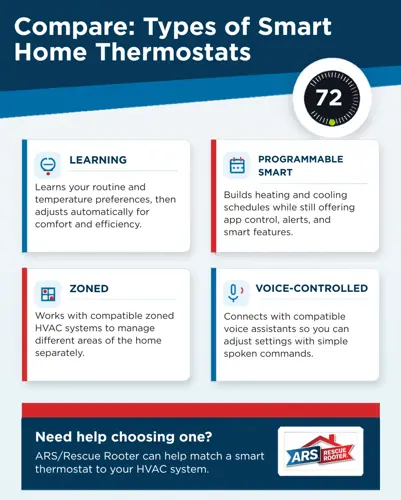
Smart thermostats are not all designed the same way. Some focus on learning your habits, while others give you more manual control, support multiple zones, or connect more deeply with your smart home setup.
Learning smart thermostats: These models learn your routine and temperature preferences, then automatically adjust to improve comfort and efficiency.
Programmable smart thermostats: These let you build heating and cooling schedules while still offering smart features like app control or alerts.
Zoned smart thermostats: These work with compatible zoned HVAC systems to manage different areas of your home separately.
Voice-controlled smart thermostats: These connect with compatible voice assistants, allowing you to adjust settings with simple spoken commands.
Smart Thermostat vs. Programmable
If you are comparing thermostat options, the biggest question is usually how much control you want and how much work you want the thermostat to handle.
A programmable thermostat lets you set a schedule, which can be helpful when your routine is predictable. In fact, the U.S. Department of Energy says, “You can save as much as 10% a year on heating and cooling by turning your thermostat back 7°–10°F for 8 hours a day.”
The catch is that programmable thermostats work best when you use them consistently. Smart thermostats build on that idea with Wi-Fi, sensors, apps, and automation that can help your system adjust more easily throughout the day.
Here are the main differences between smart thermostats and programmable thermostats.
Programmable vs. Smart Thermostat Features
Features | Programmable | Smart |
|---|---|---|
Manual Temperature Control | Yes | Yes |
Custom Scheduling | Yes | Yes |
Remote Access | No | Yes |
Mobile App Control | No | Yes |
Energy Monitoring | No | Yes |
Usage Reports | No | Yes |
Wi-Fi Connectivity | No | Yes |
Smart Home Integration | No | Yes |
Geofencing or Occupancy Sensing | No | Yes |
Automatic Learning Features | No | Yes |
Maintenance Alerts | Limited | Yes |
Is a Smart Thermostat Worth It for Your Home?
Now that you know what a smart home thermostat is, does adding one make sense for your home? For many homeowners, the answer comes down to comfort, convenience, and the level of control you want over your HVAC system. Some of the biggest reasons to buy a new thermostat include:
You want to adjust temperatures from your phone.
Your schedule changes often.
You sometimes forget to change the thermostat settings before leaving home.
You want better insight into energy use.
You already use other smart home devices.
Your current thermostat is outdated, inaccurate, or hard to use.
A smart thermostat may be worth considering if you want easier temperature control without constantly adjusting settings yourself.
Can Smart Thermostats Save Energy and Lower Utility Bills?
Smart thermostats can help lower utility bills by reducing unnecessary heating and cooling, especially when you are asleep, away, or following a changing schedule. EnergyRight notes that smart thermostats may help homeowners save an average of 8% to 10% on heating and cooling costs, with exact savings depending on your home, HVAC system, climate, settings, and energy habits.
Professional Smart Thermostat Installation Matters
A smart thermostat may look like a simple swap, but compatibility matters. Your HVAC system, wiring, voltage, and C-wire setup can all affect which thermostat will work properly in your home.
Professional installation also helps ensure the thermostat is calibrated, connected to Wi-Fi, paired with your app, and correctly integrated with your heating and cooling equipment.
ARS/Rescue Rooter can help you choose and install a smart thermostat that fits your system, so you can use the features without guessing through setup.
Get More From Your Thermostat With ARS/Rescue Rooter
A smart thermostat can make everyday comfort easier by giving you better control over your heating and cooling, whether you are home, away, or managing your system through a smart home setup.
If you are ready to compare options or want help installing the right thermostat for your HVAC system, ARS/Rescue Rooter is here to help. Call 866-399-2885 or schedule online today.
Frequently Asked Questions
Most smart thermostats need Wi-Fi to use features like app control, remote temperature adjustments, system alerts, energy reports, and smart home integration. Without Wi-Fi, many models can still control heating and cooling from the wall unit, but they may function more like a standard thermostat until the connection is restored.
The main pros and cons of a smart thermostat come down to convenience versus setup needs. Benefits include remote access, scheduling, automation, energy tracking, smart home compatibility, and potential utility savings. Potential drawbacks may include higher upfront costs, Wi-Fi dependence, compatibility limits, and the need for professional installation.


